• Skip to primary navigation
  • Skip to main content
  • Skip to footer
Vaikuttavuussaatio

Vaikuttavuussaatio

Vaikuttavuussäätiö vahvistaa ja tukee huippututkimuksen vaikuttavuutta ja elinkeinoelämän yhteyksiä.

  • FI
  • EN
  • Front page
  • Funding
    • Open and upcoming calls
    • Previous calls
    • Projects funded
      • TIA Seed (2025)
      • TIA Postdoc (2025)
      • TIA Seed (2024)
      • TIA Professor (2024)
      • TIA Postdoc (2024)
      • TIA Professor (2023)
      • TIA Postdoc (2023)
      • TIA (2022)
      • TIA Professor (2022)
      • TIA (2021)
      • TIA (2020)
      • Assessing the effectiveness of the new funding model (2020)
    • Grant application system
  • Foundation
    • About
    • Annual reports
    • Blog
    • Impact assessment
  • Publications
    • Impact assessment
    • Guide for industry–academia collaboration
    • Other publications
  • Contact

vaikuttavuussaatio

What is the state of industry-academia collaboration in the social sciences, humanities and arts? Perspectives from the Nordics and beyond

30.11.2023 by vaikuttavuussaatio

The social sciences, humanities and arts have largely been absent from the landscape of industry-academia collaboration. Our 2023 whitepaper explores the relationship between these disciplines and industry collaboration and looks for ways of removing barriers to collaboration.

Whitepaper: State of industry-academia collaboration in humanities, arts and social sciences

Format: pdf
Size: 5,5 MB
Download here

In recent years public debate has increasingly highlighted the relevance of the social sciences, humanities and arts in understanding humanity, the functioning of society and addressing societal challenges. It is widely recognised that these disciplines can contribute to the positive development of society. However, it is still rare for these disciplines to actively collaborate with private enterprises in the same way that is typical for STEM (science, technology, engineering and mathematics) disciplines. Joint research projects are not common between companies and SHAPE researchers. 

In 2023, we conducted an investigation into this topic that included a roundtable with representatives of Finnish academic institutions and other stakeholders, in-depth qualitative interviews with European experts and an online survey for Finnish academic and industry representatives. 

The results of these inputs are now summarised in a whitepaper that we published on the 30th of November 2023. The purpose of this whitepaper is to contribute to the discussion on how impactful collaboration between SHAPE disciplines and industry could be furthered to benefit academic research, industry and society as a whole. Our aim is to encourage both academics and industry representatives to engage with this information and to use it to inspire and shape future collaboration.  

Industry-academia collaboration is a key way of achieving impact for scientific research

Collaboration with private enterprises is a key way of achieving impact for scientific research. It can provide researchers with access to unique data, demonstrate the impact of research in practice and help in scaling research findings to benefit society more broadly. In return, collaboration can equip enterprises to better meet future challenges.

Traditionally, the STEM disciplines (science, technology, engineering and mathematics) have been more active in collaborating with the private sector when compared to the so-called SHAPE disciplines. Coined by the British Academy in 2020, SHAPE is an acronym for “Social Sciences, Humanities, and the Arts for People and the Economy”. It is an update to the previously used acronyms SSH and AHSS. 

Traditionally, the STEM fields are more concerned with the straightforward commercialisation of science and thus with outcomes, such as the application of patents, the selling of licences and setting up spin-out companies than SHAPE fields. All these outcomes are measurable, making it easier to demonstrate the impact of STEM research.

In contrast, research in SHAPE disciplines is often more qualitative and abstract, making it harder to articulate the societal impact of this work. People working in the business sector may also struggle to see the practical applications of SHAPE research. This is reflected in the funding applications received by the Finnish Research Impact Foundation. Only 8% of all applications represent projects that involve SHAPE disciplines. 

However, SHAPE research can provide industries with creative approaches, analytical tools and the human perspective they need to address complex social phenomena, such as the impact of AI on work and human interaction or social and environmental sustainability issues. By providing in-depth understanding of human behaviour, culture, creativity, history and society, SHAPE research can drive ethical and sustainable innovation as well as the development of innovative cultures in organisations.

A multitude of current trends in industry and society suggest that now is the time to investigate the value of the social sciences, humanities and arts to the private sector and our societies. These four current societal trends demand collaboration between SHAPE disciplines and enterprises:

  • Societies are grappling with human problems that require multifaceted solutions.
  • Artificial intelligence is shaping the way we work, interact and manage human relationships.
  • The climate crisis is not being solved by STEM alone.
  • Customer-centricity is the driving force behind successful businesses.

What is the current status quo of industry-academia collaboration within SHAPE disciplines?

We asked academics to describe what their collaboration with industry partners currently looks like. The results show that the collaboration can deliver several benefits for both parties involved. 

Our survey results show that academics see industry collaboration as a great opportunity to widen their professional networks and increase the impact of their research. Having access to new contacts ties in with increasing research impact because speaking to new audiences brings the research out of the university and into the wider society.
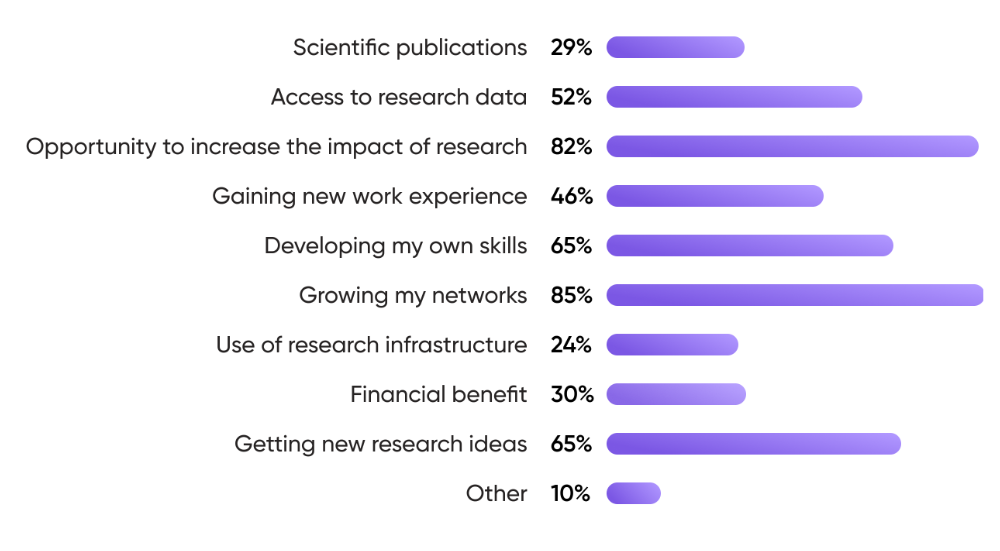
What specific benefits or value do you see for your research in working with companies?
(Respondents: academics, n=107)

Societal impact was a benefit that came across frequently in our in-depth interviews with experienced collaborators and experts. It was also mentioned by enterprises as an important outcome of these collaborations. It appears that societal impact is a key benefit that can equally motivate both parties to engage with one another.
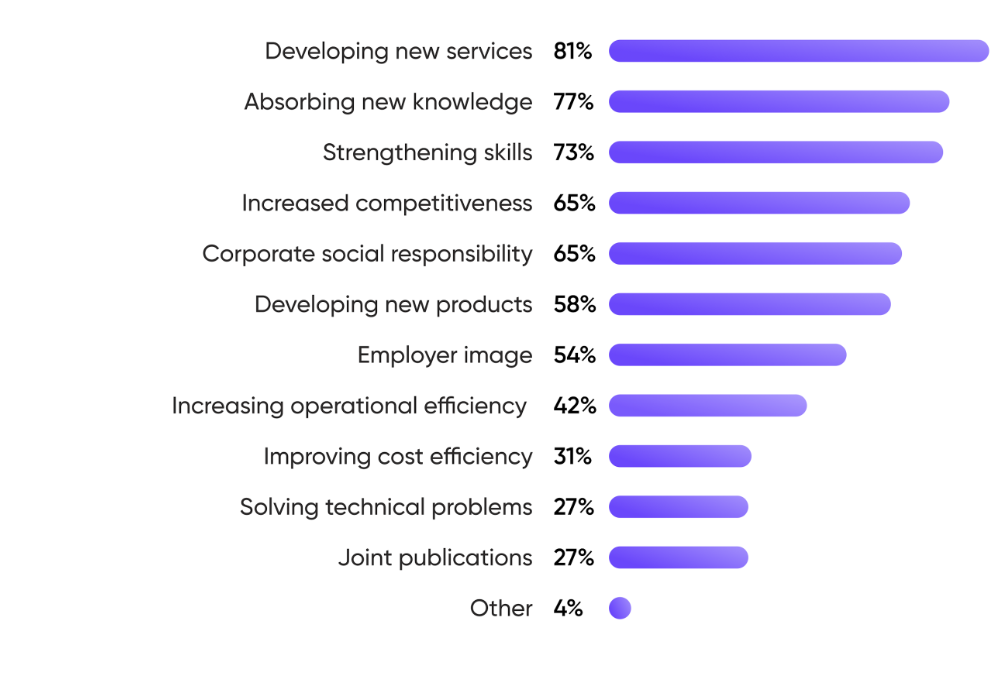
What specific benefits or value do you see for the company in working with researchers in the human sciences? (Respondents: industry representatives, n=26)

What stands in the way of industry-academia collaboration in the SHAPE context?

Our data shows that both academics and enterprises can derive benefits from collaborating with one another. Yet, industry-academia collaboration is not widespread in the SHAPE context. We wanted to understand what is keeping researchers and enterprises from working together so that we could then imagine viable solutions. In our survey we asked academics and enterprises to give open-ended answers to this question and discovered several obstacles to collaboration that we then labelled under the following seven categories. Because we received significantly more replies from academics than enterprises, the categories presented here are more representative of the academic perspective.
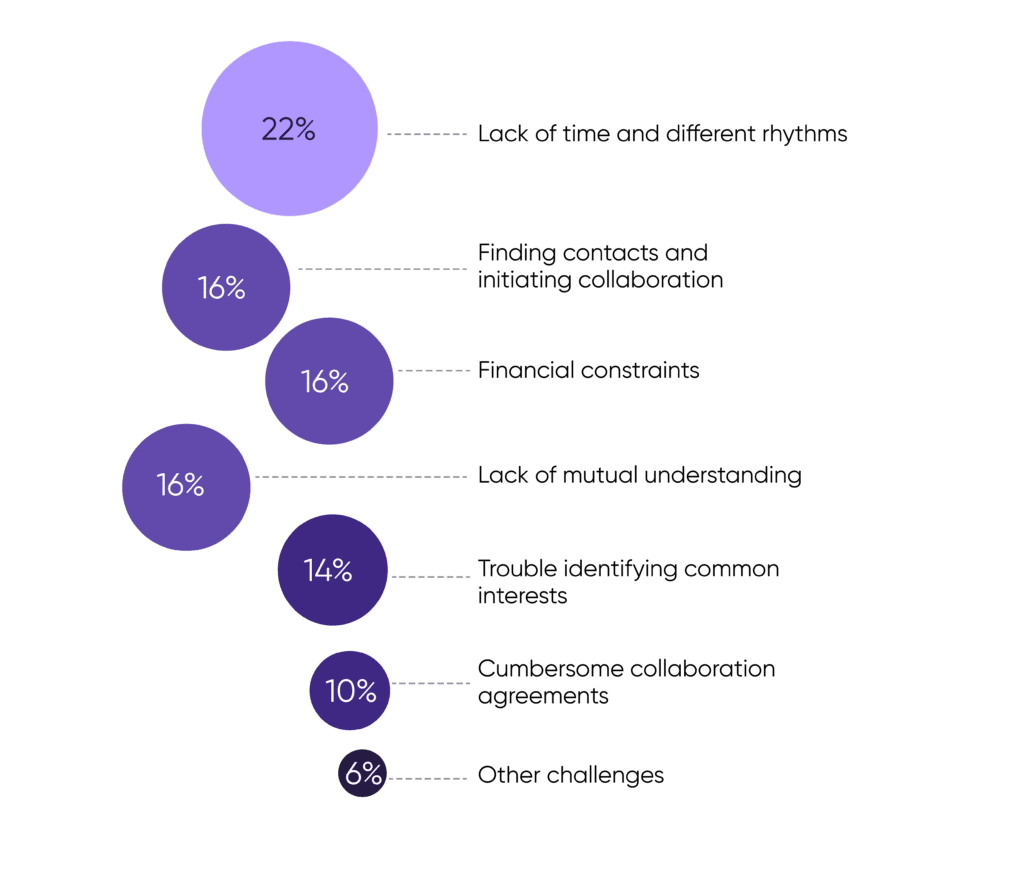
What obstacles and challenges have you encountered in working with and creating collaboration with companies? (Respondents: Academics and industry respondents, n=103)

How to move on and enhance collaboration between SHAPE disciplines and private enterprises

The future of research is grounded in collaboration. As public funders encourage universities and research institutions to show more leadership in creating societal and economic impact, all disciplines will be affected, including SHAPE. The question is not whether there should be more collaboration between SHAPE and private enterprises, but how that collaboration should be increased and who needs to be involved.

Our findings conclude that the task of enhancing collaboration cannot be accomplished by any one funder, higher education institution, academic or enterprise alone. The necessary changes may be structural, political and technical, but none of these changes can happen without dialogue and collaboration among all the parties involved.

Systemic approaches to collaboration need to be developed to increase collaboration

The challenge: SHAPE researchers and enterprises share a mutual interest in working with each other but struggle to make this happen. The birth of successful collaborations is dependent on individual awareness and interest, and on chance. A more systemic approach requires involvement on the part of universities, academics, funders and enterprises. 

Potential solutions could include:

  • Creating funding calls that are targeted at SHAPE disciplines and that encourage industry-academia collaboration.
  • Supporting academics and enterprises to set up mutually beneficial projects.
  • Setting up structures within universities to exhibit and introduce the work of social sciences, humanities and arts researchers to the private sector.
  • Increasing diversity in corporate leadership to include people with backgrounds in the social sciences, humanities and arts or educating current staff about the benefits these disciplines can offer.
  • Facilitating open-minded discussions about what it means to be an academic who collaborates with the private sector, exchanging experiences with other academics and defining the benefits of this type of collaboration from the academic’s perspective.

Industry-academia networks are key in facilitating collaboration

The challenge: SHAPE academics typically work in very small teams or alone and on small budgets. The lack of teamwork and large-scale projects limits the number of potential contacts for these academics and means they cannot create extended networks through other team members. Without appropriate networks, it is hard to imagine a collaborative project, contact potential collaborators or apply for funding.

Potential solutions could include:

  • Building interdisciplinary teams that help to broaden networks and make new connections.
  • Creating networking events where researchers and enterprises can meet.
  • Encouraging brokerage from universities to establish relationships and connect the right academics with the right enterprises.
  • Creating easy-to-access digital platforms or university consultancies that can help enterprises get in touch with the right researchers.

We need more versatile means to discuss and evaluate research impact

The challenge: In private enterprises, the language and discourse of impact are typically focused on economic outcomes and quantifiable results. Success is measured in terms of patents, products and revenue, which are typically not areas in which SHAPE disciplines can bring most value. Because of this, SHAPE disciplines are often excluded from traditional innovation and R&D spaces but rather employed in other areas of business, such as organisational development. This is not necessarily a problem, but it can limit the potential of academia-industry collaboration and reduce its impact.

Potential solutions could include:

  • Increasing data and evidence on the impact of collaboration through carefully designed trials.
  • Developing impact measures that reflect the unique nature of SHAPE research.
  • Defining the added value that SHAPE disciplines can bring and communicating it effectively, also through quantifiable measures.
  • Challenging the language of innovation and impact to embrace not just economic but also societal, environmental and other types of impact.
  • Providing academics with the necessary skills to talk about their research from the perspective of impact. 
  • Demonstrating case studies of successful collaborations and their impact on both parties involved.

Are you interested in finding out more about the potential solutions that have already been tested or trialed across Europe to increase collaboration between SHAPE disciplines and private enterprises? Download our whitepaper and to learn more about: 

  • Findings from our survey on industry-academia collaboration among Finnish academics and industry representatives.
  • Case studies from Finland, Sweden, Denmark, Ireland and the UK that describe the different approaches to increasing collaboration between SHAPE disciplines and enterprises. 
  • An executive summary that presents all our findings and proposed solutions to take action. 

Would you like to learn more about the whitepaper, please contact the authors: 

aurora.airaskorpi@vaikuttavuussaatio.fi
outi.vanharanta@vaikuttavuussaatio.fi

Author: Aurora Airaskorpi
Filed Under: Blog

Three new professors receive FRIF funding for one-year industry placements

23.11.2023 by vaikuttavuussaatio

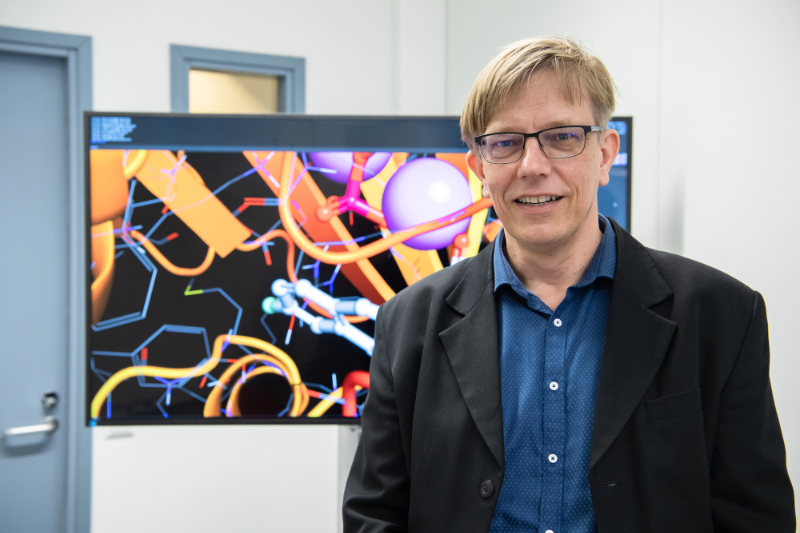
Antti Poso, Professor of Drug Design at the University of Eastern Finland, is one of the three recipients of funding from the FRIF. Photo: Raija Törrönen.

The Finnish Research Impact Foundation’s new funding scheme gives professors the opportunity to spend one year working on their research with an industry partner, in an industry environment. In all, nine professors have received TIA Professor grants since the scheme was launched in 2022.

The Tandem Industry Academia Professor (“TIA Professor”) funding scheme gives professors the opportunity to focus on their own research work and to leverage companies’ expertise and resources.

At its 17 November 2023 meeting the FRIF Board decided to award TIA Professor funding to three new professors:

  • Antti Poso, Professor of Drug Design, University of Eastern Finland, in partnership with Orion Pharma
  • Roope Raisamo, Professor of Computer Science, Tampere University, in partnership with Nokia Technologies
  • Ari Väänänen, Research Professor, Finnish Institute of Occupational Health, in partnership with Terveystalo Healthcare

“FRIF recognizes a clear need to provide funding support to advanced-career researchers so that they can effectively join forces with companies. FRIF funding allows professors to update their expertise on research questions that are relevant to companies, and at the same time it paves the way for high-level, high-impact research,” says Leena Otsomaa, member of the task force that developed the funding model and FRIF Board member.  

Research Professor Ari Väänänen from the Finnish Institute of Occupational Health has launched a joint project with Finnish healthcare provider Terveystalo to search for new information and new approaches to addressing mental health challenges using machine learning models and data resources. “When you can work closely in this way with a business partner, the TIA professorship opens new vistas onto the workings of occupational healthcare and its acute challenges. The observations and discoveries made in this collaboration create new lines of research leading to new scientific breakthroughs and high-level research publications.”

During their funding term TIA professors spend a period equivalent to one full year working in facilities provided by the business partner. The funding may be spread out over a maximum of three years. The purpose of the funding scheme is to support collaborations between industry and research organizations and to give professors first-hand knowledge about relevant areas of research interest in industry. Projects may involve joint precompetitive research and other supportive activities.

The three new TIA professors will be working on projects that deal with mental health support, haptic technologies in the metaverse, and quantum technology and machine learning assisted drug discovery. For more details on these projects go to: https://www.vaikuttavuussaatio.fi/en/funded-projects/

Professor Antti Poso from the University of Eastern Finland says his TIA professorship will allow him not only to advance his own research but also to supervise his students in such a way that their research has greater impact outside of academia.

“In practice the only way to bring new drugs within the reach of patients is via industry. This collaboration will allow us to combine theoretical expertise with hands-on practical experience – and in this way support and promote research in this field and bolster the success of business companies,” professor Poso explains.

Professor of Computer Science Roope Raisamo from Tampere University has launched a joint project with Nokia to explore ways of introducing the sense of touch into the metaverse.

“Nokia Technologies is a leading player in metaverse infrastructure development. The results of this collaboration will lend support to international standardization efforts,” professor Raisamo says.

Filed Under: Blog

Webinar: What is the state of industry-academia collaboration in humanities, arts and social sciences?

30.10.2023 by vaikuttavuussaatio

Join us on 30 November at 12.30-14.00 (GMT+2) for our webinar and launch event on the state of industry-academia collaboration in humanities, social sciences and arts.

Six months ago, the Finnish Research Impact Foundation started an investigation into the current status and future possibilities for collaboration between humanities, arts and social sciences and private enterprises. This investigation has included a roundtable with representatives from the Finnish academic institutions and other stakeholders, in-depth qualitative interviews with European experts and an online survey for Finnish academic and enterprise representatives.

Now we’re about to launch our discoveries. Join us for this unique webinar to hear new perspectives into industry-academia collaborations from the Nordics and the United Kingdom. You will learn from the insights we have gathered and hear keynotes from Julia Black (British Academy), Alf Rehn (University of Southern Denmark), and Marja-Liisa Niinikoski (Finnish Textile and Fashion Association).

Sign up

The event will be hosted on Zoom and recorded for future use. By signing up to the webinar you can opt to receive the whitepaper in your inbox. The whitepaper will also become available for download on this website on the 30th of November 2023 at 12 pm.

Programme

(in FI time, GMT+2)

12.30 Opening words and key insights from our whitepaper State of industry-academia collaboration in humanities, arts and social sciences – Perspectives from the Nordics and beyond

Aurora Airaskorpi & Outi Vanharanta, writers of the whitepaper

12.45 Keynote: State of SHAPE innovation – Insights from five years of building a network of universities to support SHAPE innovation in the UK and beyond

Professor Julia Black, Chair of the ASPECT Steering Group and President of the British Academy

13.00 Q&A with Julia Black

13.05 Keynote: Industry-Academia Collaboration: Alignment, Asymmetries, Anarchy, and Apotheoses

Alf Rehn, Professor of Innovation, Design, and Management at the University of Southern Denmark 

13.20 Q&A with Alf Rehn

13.25 Keynote: The contradictory role of arts, humanities and social sciences in the transformation of industries. Case textile and fashion industry

Marja-Liisa Niinikoski, Managing Director of Finnish Textile and Fashion Association

13.40 Q&A with Marja-Liisa Niinikoski

13.45 Closing words and next steps from the Finnish Research Impact Foundation

Petro Poutanen, CEO, The Finnish Research Impact Foundation

Speakers

Aurora Airaskorpi is the author of the whitepaper State of Industry-Academia Collaboration in Humanities, Arts, and Social Sciences. Specializing in scientific and societal topics, she’s an independent writer and coach and works in close collaboration with the Finnish Research Impact Foundation. She explores creativity, freelancer culture, and artist careers in her 2022 book, Freedom Seekers. Through her business High on Hope, she coaches entrepreneurs, creatives and researchers with projects and businesses that strive for societal impact. She holds a Master’s Degree in social sciences.

Outi Vanharanta is the Research Impact Officer at the Finnish Research Impact Foundation. She is dedicated to unravelling the wide range of impacts of industry-academia collaboration and developing new ways to foster partnerships between academic researchers and industry. She holds a PhD in Economics and Business Administration and has over ten years of experience in research collaboration with large companies and SMEs. 

Julia Black, President of the British Academy.She is also strategic director of innovation and professor of law at the London School of Economics and Political Science, and specializes in the legitimacy and dynamics of regulatory systems. She has advised global policymakers, consumer bodies, and regulators, holding key roles in institutions like the Bank of England,  Prime Minister’s Council of Science and Technology and the UK Research and Innovation Council. Julia is also a director of Zinc, a social sciences, mission-based incubator.

Alf Rehn is professor of innovation, design, and management at the University of Southern Denmark, and has previously held professorships in both Finland and Sweden. He has been referred to as a thought leader in innovation, creativity, and leadership, has worked as a board professional, and is currently an internationally active keynote speaker and strategic advisor, collaborating with corporations on a near-daily basis.

Marja-Liisa Niinikoski is the Managing Director of Finnish Textile & Fashion. Prior to this position, she has worked as the CEO of companies providing expert services and, among other things, as a postdoctoral researcher at Aalto University.

Petro Poutanen is a recognized expert in the fields of corporate communication, societal impact, innovation, and creativity. He holds the position of CEO at the Finnish Research Impact Foundation (FRIF), an organization established by the Finnish government in 2019 to foster public-private partnerships and facilitate interaction between industrial and academic stakeholders.

Filed Under: Blog

FRIF allocates 2.1 million euros in research funding to help bridge the gap between RDI and basic research

31.8.2023 by vaikuttavuussaatio

The Finnish Research Impact Foundation has announced its decision to award a total of 2.1 million euros to support 10 cutting-edge research projects that are teaming up with corporate partners to tackle major challenges. Research topics range from the treatment of corneal blindness to the development of growth substrates that could serve as alternatives to peat.

The Finnish Research Impact Foundation is allocating 2.1 million euros to support joint research projects between universities and industry partners. FRIF’s fourth round of calls for Tandem Industry Academia Postdoc funding invited applications from projects aimed at achieving both academic and commercial impact together with corporate partners. Since 2019, FRIF has awarded funding worth around nine million euros to a total of 46 such projects.

Aimed at Finnish universities and research institutes, FRIF funding is intended to encourage their cooperation with the Finnish business sector. The Foundation’s mission is to help bring together academic excellence with business and industry resources.

The projects funded under this year’s call address several challenges with major social significance. They include research aimed at accelerating and intensifying drug development, enhancing Finnish expertise in lithium battery technology, cancelling interference in wireless communications networks, creating more effective treatments for corneal blindness and developing alternative growth substrates to peat. 

The research teams behind the 10 projects receiving FRIF funding in 2023 come from the University of Helsinki, Aalto University, Tampere University, the University of Turku and the University of Eastern Finland.

The corporate partners involved in the projects contribute their R&D expertise as well as their knowledge of core issues in their field. The corporate partners in the 10 projects are Fenno-Aurum, Bittium Wireless Communications, Pulsedeon, Comptek Solutions, Planmeca, AGCO Power, Neova Group, StemSight, Bionavis and OrionPharma.

Kuvaaja: Maarit Kytöharju" / "Photo: Maarit Kytöharju

“FRIF funding can help to bridge the gap that continues to remain between basic scientific research and industrial RDI. It allows us to push the boundaries of research further than is usually the case with publicly funded basic research and in this way provides an opportunity to demonstrate the significance and practical applicability of research results to the business partner as well,” says Taneli Riihonen, Professor of Electrical Engineering at Tampere University. He is principal investigator in a joint project with Bittium Wireless Communications, where the research team are working to produce new research data on methods of cancelling radio interference in wireless networks.

More information on the projects funded is available on the FRIF website at https://www.vaikuttavuussaatio.fi/en/funded-projects/.

FRIF’s funding call closed on 16 April 2023 and attracted 78 applications. The FRIF Board decided to award funding to the top 10 projects that represent the highest international standard and that are expected to deliver greater impact by virtue of their collaboration with corporate partners. The projects involve precompetitive research, which will yield not only important scientific results but also enhance the competencies and competitiveness of Finnish industry.

The new funding model developed by the Finnish Research Impact Foundation allows the academic research team and the business partners to genuinely commit themselves to research-driven cooperation.

Lauri Oksanen, Chairman of the Board, the Finnish Research Impact Foundation.

“Most research cooperation in Finland is funded from a business point of view and close to the market, but in many cases business and industry resources are also useful for academically-driven research projects, and the cooperation will help to grow the business partner’s expertise,” says Lauri Oksanen, Chairman of the Board of the Finnish Research Impact Foundation.

Projects funded under the Tandem Industry Academia Postdoc scheme involve an academic researcher representing a university or research institute working for 12 months with their host academic organization and another 12 months more closely with the project’s industry partner.

“FRIF funding helps to bridge the gap that remains in the Finnish RDI field between academic research and innovation funding and expedites the translation of research results into solutions that benefit society,” Oksanen explains.

FRIF will open a funding call for professor-level researchers on 4 September 2023, providing an opportunity for professors working at Finnish universities and research institutes to work for a full year with a business company.

Filed Under: Blog

Finding solutions to the sustainability transition not possible without science

25.8.2023 by vaikuttavuussaatio

The Tandem Industry Academia Professor funding programme allows experienced researchers to work on dedicated research projects in a corporate environment. Jari Hyväluoma from the Natural Resources Institute Finland and Saara Kankaanrinta from Soilfood explain how research collaboration benefits the partners involved in joint research projects as well as society at large. 

Professor Jari Hyväluoma today spends most of his time either writing code on a computer, digging up soil in a field or analysing soil samples in the laboratory. He’s in the process of developing what is known as a flow modelling method, which will help to understand how soil improvement fibres affect soil structure and thus the water conductivity of soil. 

Hyväluoma and his team are working in a FRIF-funded joint project between the Natural Resources Institute Finland and Soilfood, a Finnish circular economy company that produces wood-based soil improvement fibres. The project is intended to explore the effects of soil improvement fractions produced from forest industry side streams on the structure of arable land. Funding was granted in December 2022, and the project has now completed its six-month start-up phase. 

“Soil structure research is obviously closely dependent on seasonal conditions. We have spent the spring developing the methods we will need and analysing the relevant background data. At the moment we are preparing for sample collection after threshing,” Hyväluoma says.

The depletion of organic matter in soil is a global problem that has also been observed in arable land in Finland. Apart from its climatic impacts, the depletion of organic matter weakens the growth potential of soil. The project’s results will benefit not only stakeholders in the agricultural sector but also support soil carbon sequestration, reduce the burden of agriculture on waterways and improve crop yields from available arable land.

“Finding solutions to the sustainability transition is not possible without science,” says Saara Kankaanrinta. She is founder not only of Soilfood but also the Baltic Sea Action Group, a non-profit foundation committed to saving the Baltic Sea. Kankaanrinta received the Globe Energy Award in 2019.

The company’s collaboration with Professor Hyväluoma’s project means that Soilfood has immediate access to the research results and that they can put them to good use in product development, but also communicate them to the outside world. “Research collaboration is not just about producing added value and growth for the company. Solving the major crises facing society is equally important,” Kankaanrinta points out. “We need to be able to show both to farmers and to society why the circular economy is so important and what value our products have for the soil and the environment. Our aim is to provide solid scientific evidence on what is happening in the soil.”

This is why Professor Hyväluoma is devoting his time to gain an in-depth understanding of the structure and growth conditions of soil. “I think our project finely brings together the examination of the effects of Soilfood’s soil improvement fibres and the solution of research problems related to soil structure. In my researcher role I get to make use of the existing knowledge and practical experiences of the effects of soil improvement fibres and to tie this all in with my research expertise,” Hyväluoma says. 

Research collaboration is a great way to support corporate R&D work, but Kankaanrinta is keen to stress that the search for solutions to the sustainability transition should not be exclusively focused on product innovations. She emphasizes the key importance of basic research, which is essential to learning how to strengthen and improve biodiversity and well-being. “There is no technical silver bullet that will solve all soil problems, i.e. climate change, disruptions in the water cycle and biodiversity loss. We must also change our current practices and ways of working.” 

Climate change is also bound to bring changes to farming, which means that farmers must learn to adapt to extreme weather conditions and to crises driven by climate change. Soil improvement fibres will provide much-needed water retention capacity in the event of excessive dryness or wetness. Indeed, Kankaanrinta feels that, along with the research institute and business collaboration, farmers are an important third party in this project. 

“The impact of the research knowledge we produce will ultimately be measured in terms of whether the improvement of soil conditions and the value of nutrient recycling can be justified to farmers and the profitability of their business be improved,” she says. “In the end, of course, we will also need a social governance policy because we are working to solve common crises.”

Explore the TIA Professor 2023 call and register for the info session on September 4th!

Filed Under: Blog

The Foundation studies business cooperation in human sciences – take part in the survey!

16.8.2023 by vaikuttavuussaatio

The Finnish Research Impact Foundation is conducting a study on collaboration between human sciences and business in Finland. Our aim is to gain a better understanding of how and what kind of collaboration between companies and human science researchers takes place and how this collaboration could be supported and promoted. By human sciences we refer to both the humanities and social sciences.

We hope that you could provide input on your experiences and views on collaboration between human sciences and business by answering our survey. The survey is designed to be easy to complete and will take about 10 minutes. All responses will be treated confidentially and no individual responses will be shared with any third party. The privacy policy of the survey can be found here.

By answering this questionnaire, you will help us and other funders to develop better ways of funding and supporting collaboration between human sciences and business. Our aim is to create policies and tools that benefit both business and human sciences research.

We will draw two €50 restaurant gift vouchers among all those respondents who leave their contact details.

Participate here: https://link.webropolsurveys.com/S/4CD22EB7FC942837

We hope to receive your reply by 8.9.2023 at the latest. Thank you for your participation and your valuable contribution to our research!

Filed Under: Blog

  • « Go to Previous Page
  • Page 1
  • Interim pages omitted …
  • Page 6
  • Page 7
  • Page 8
  • Page 9
  • Page 10
  • Interim pages omitted …
  • Page 17
  • Go to Next Page »

Footer

Vaikuttavuussäätiö

Eteläranta 10, 00130 Helsinki
+358 40 767 1631
petro (at) vaikuttavuussaatio.fi

Billing Information →

  • Facebook
  • Instagram
  • LinkedIn
  • Twitter

Privacy Policy →

Copyright © 2026 Vaikuttavuussäätiö