• Skip to primary navigation
  • Skip to main content
  • Skip to footer
Vaikuttavuussaatio

Vaikuttavuussaatio

Vaikuttavuussäätiö vahvistaa ja tukee huippututkimuksen vaikuttavuutta ja elinkeinoelämän yhteyksiä.

  • FI
  • EN
  • Front page
  • Funding
    • Open and upcoming calls
    • Previous calls
    • Projects funded
      • TIA Postdoc (2025)
      • TIA Seed (2024)
      • TIA Professor (2024)
      • TIA Postdoc (2024)
      • TIA Professor (2023)
      • TIA Postdoc (2023)
      • TIA (2022)
      • TIA Professor (2022)
      • TIA (2021)
      • TIA (2020)
      • Assessing the effectiveness of the new funding model (2020)
    • Grant application system
  • Foundation
    • About
    • Annual reports
    • Blog
    • Impact assessment
  • Publications
    • Impact assessment
    • Other publications
  • Contact

vaikuttavuussaatio

Annual Report Summarizes Key Events of 2023

27.5.2024 by vaikuttavuussaatio

Vaikuttavuussäätiön vuosikertomus kokoaa säätiön vuoden 2023 kohokohdat yhteen ja kertoo toiminnastamme. Vuoden 2023 teemana oli SHAPE-alojen (ihmistieteiden alojen tutkimus) ja yritysten yhteistyön nykytilan selvittäminen ja keskustelun käynnistäminen aiheesta.

Vuoden 2023 aikana Tandem Industry Academia Postdoc -haun neljäs kierros keräsi 80 hakemusta – rahoituspäätökset tehtiin elokuussa, ja 10 hanketta sai rahoitusta. Hakumäärä kaksinkertaistui vuodesta 2022. Syksyllä 2023 säätiö järjesti toisen hakukierroksen professoreille suunnatusta Tandem Industry Academia Professor -rahoituksesta. Professoreille suunnattu rahoitus on kerännyt kasvaa kiinnostusta, ja säätiö myönsi vuonna 2023 kolmelle professorille TIA Professor -rahoituksen.

Vuosikertomuksesta voit esimerkiksi tutustua toimitusjohtaja Petro Poutasen kirjoitukseen SHAPE-alojen roolista innovaatiojärjestelmässä sekä tutkia säätiön vuoden avainlukuja ja -tapahtumia!
Lue vuosikertomus täältä →

Filed Under: Blog

Tandem Industry Academia Postdoc received 61 applications

22.4.2024 by vaikuttavuussaatio

The Foundation received 61 joint applications from research organizations and companies for the Tandem Industry Academia Postdoc 2024 funding call, which closed on April 14, 2024. Funding decisions will be made in August 2024, with the first projects scheduled to commence in the autumn of the same year. On average, 71 applications are received annually.

TIA Postdoc funding, developed by the Foundation, is aimed at ambitious research-oriented projects conducted jointly by research organizations and companies, advancing the goals of cutting-edge research and the business sector.

TIA Postdoc call has been organized since 2020, with the recent round being the fifth. A total of 40 two-year projects have been funded so far, with a total funding of 8 million euros.

Third round of TIA Professor funding in the works

In autumn 2022, the Foundation piloted the TIA Professor funding aimed at professors, awarding funding to 6 professors. In 2023, funding was granted to 3 professors. The Foundation plans to continue the TIA Professor funding in late 2024. Further details about the call will be announced on the Foundation’s website during the summer.

Filed Under: Blog

Book a coaching session for the Tandem Industry Academia Postdoc 2024 application!

4.3.2024 by vaikuttavuussaatio

Tandem Industry Academia Postdoc (TIA Postdoc) call is open from 4 March to 14 April 2024. Read more about the call here and carefully read the guidelines before submitting your application.

Do you have questions about the application process or the evaluation? Experts from the Finnish Research Impact Foundation will answer applicants’ questions in one-to-one video meetings.

Book yourself a 30-minute sparring session with the Foundation’s experts using this link.

Please note that a limited number of slots are available. If you cannot find a suitable time or all times are full you can also email us or contact us by phone. See the Foundation’s contact details here.

The recording of the TIA Postdoc application info session on March 4, 2024

Filed Under: Blog

5th round of the Tandem Industry Academia Postdoc call opens in March 2024

15.2.2024 by vaikuttavuussaatio

The 5th round of the Finnish Research Impact Foundation’s Tandem Industry Academia Postdoc (TIA Postdoc) call will open in March 2024. The application period is from 4 March to 14 April. Applications must be submitted to the Foundation via the electronic grant system by 14 April at 23:59. The Industrial partner submits its own application no later than 7 days after the call closes.

Please read the call info and the updated application guidelines carefully in advance. The application form will be open for registration from 4 March.

We will organize an Info Session on 4 March at 9:30. Register for the webinar here. You will receive a link by email before the event. During the event, you will have the opportunity to ask questions to the Foundation about the application process. The information part of the event will also be available for viewing afterwards.

TIA Postdoc funding supports joint research projects between academic and industrial partners, and it is aimed at encouraging ambitious precompetitive projects that further the aims of both leading-edge academic research and business and industry. In a TIA Postdoc project, a post-doctoral researcher works closely with an academic partner for half of the project duration and with an industrial partner for the other half.

Filed Under: Blog

Launch webinar of the State of research collaboration in the human sciences report is now available for viewing

20.1.2024 by vaikuttavuussaatio

A recent report by the Finnish Research Impact Foundation, published in November 2023, opens up interesting perspectives on the role and opportunities of business collaboration in the social sciences, humanities and arts research. The launch event of the report on 30 November provided an opportunity to learn more about the main findings and to hear from top international experts at the interface between academia and business.

Julia Black, Chair of the UK based ASPECT network, highlighted the role of commercialisation in promoting the impact of research in the social sciences, humanities and arts. She presented concrete examples of the network’s projects where research results have been successfully commercialised and scaled up for the benefit of society.

Professor Alf Rehn from the University of Southern Denmark highlighted the complexity of industry academia collaboration. His message was clear: collaboration is neither straightforward nor unproblematic. Successful collaboration requires open dialogue, an open-minded attitude and the ability to recognise the inevitable asymmetry between academia and industry.

Marja-Liisa Niinikoski, Managing Director of the Finnish Textile & Fashion Association, shared her views on the role of social sciences, humanities and arts research in the transformation of the textile industry. According to her, the role of these disciplines is not to provide unambiguous solutions, but to challenge traditional ways of thinking about problems and to provide a variety of perspectives. Such an approach is needed as part of interdisciplinary research to promote digitalisation, the green transition and changing consumption patterns in the textile and fashion sector.

The debate on business collaboration in the social sciences, humanities and arts has generated widespread interest. The webinar was attended by more than 100 people, and the experts’ presentations generated lively discussion and comments. We encourage academic organisations, businesses and funders alike to use the knowledge base provided by the report to further opportunities for collaboration in their own fields.

The webinar recording

Filed Under: Blog

What is the state of industry-academia collaboration in the social sciences, humanities and arts? Perspectives from the Nordics and beyond

30.11.2023 by vaikuttavuussaatio

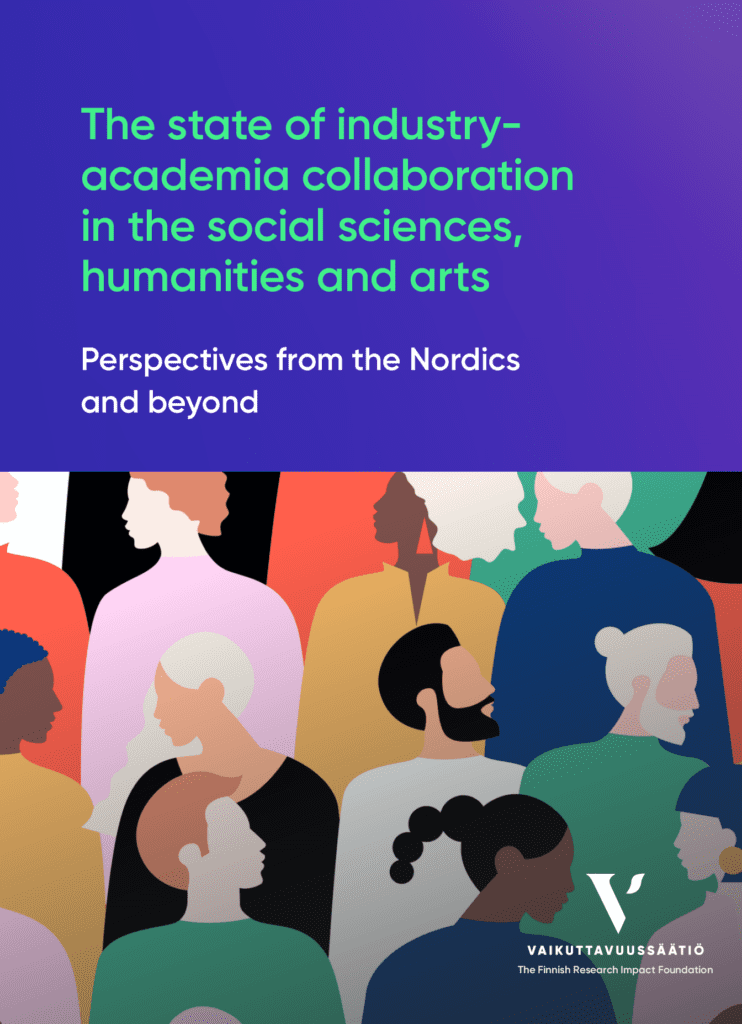
The social sciences, humanities and arts have largely been absent from the landscape of industry-academia collaboration. Our 2023 whitepaper explores the relationship between these disciplines and industry collaboration and looks for ways of removing barriers to collaboration.

Whitepaper: State of industry-academia collaboration in humanities, arts and social sciences

Format: pdf
Size: 5,5 MB

Download here

In recent years public debate has increasingly highlighted the relevance of the social sciences, humanities and arts in understanding humanity, the functioning of society and addressing societal challenges. It is widely recognised that these disciplines can contribute to the positive development of society. However, it is still rare for these disciplines to actively collaborate with private enterprises in the same way that is typical for STEM (science, technology, engineering and mathematics) disciplines. Joint research projects are not common between companies and SHAPE researchers. 

In 2023, we conducted an investigation into this topic that included a roundtable with representatives of Finnish academic institutions and other stakeholders, in-depth qualitative interviews with European experts and an online survey for Finnish academic and industry representatives. 

The results of these inputs are now summarised in a whitepaper that we published on the 30th of November 2023. The purpose of this whitepaper is to contribute to the discussion on how impactful collaboration between SHAPE disciplines and industry could be furthered to benefit academic research, industry and society as a whole. Our aim is to encourage both academics and industry representatives to engage with this information and to use it to inspire and shape future collaboration.  

Industry-academia collaboration is a key way of achieving impact for scientific research

Collaboration with private enterprises is a key way of achieving impact for scientific research. It can provide researchers with access to unique data, demonstrate the impact of research in practice and help in scaling research findings to benefit society more broadly. In return, collaboration can equip enterprises to better meet future challenges.

Traditionally, the STEM disciplines (science, technology, engineering and mathematics) have been more active in collaborating with the private sector when compared to the so-called SHAPE disciplines. Coined by the British Academy in 2020, SHAPE is an acronym for “Social Sciences, Humanities, and the Arts for People and the Economy”. It is an update to the previously used acronyms SSH and AHSS. 

Traditionally, the STEM fields are more concerned with the straightforward commercialisation of science and thus with outcomes, such as the application of patents, the selling of licences and setting up spin-out companies than SHAPE fields. All these outcomes are measurable, making it easier to demonstrate the impact of STEM research.

In contrast, research in SHAPE disciplines is often more qualitative and abstract, making it harder to articulate the societal impact of this work. People working in the business sector may also struggle to see the practical applications of SHAPE research. This is reflected in the funding applications received by the Finnish Research Impact Foundation. Only 8% of all applications represent projects that involve SHAPE disciplines. 

However, SHAPE research can provide industries with creative approaches, analytical tools and the human perspective they need to address complex social phenomena, such as the impact of AI on work and human interaction or social and environmental sustainability issues. By providing in-depth understanding of human behaviour, culture, creativity, history and society, SHAPE research can drive ethical and sustainable innovation as well as the development of innovative cultures in organisations.

A multitude of current trends in industry and society suggest that now is the time to investigate the value of the social sciences, humanities and arts to the private sector and our societies. These four current societal trends demand collaboration between SHAPE disciplines and enterprises:

  • Societies are grappling with human problems that require multifaceted solutions.
  • Artificial intelligence is shaping the way we work, interact and manage human relationships.
  • The climate crisis is not being solved by STEM alone.
  • Customer-centricity is the driving force behind successful businesses.

What is the current status quo of industry-academia collaboration within SHAPE disciplines?

We asked academics to describe what their collaboration with industry partners currently looks like. The results show that the collaboration can deliver several benefits for both parties involved. 

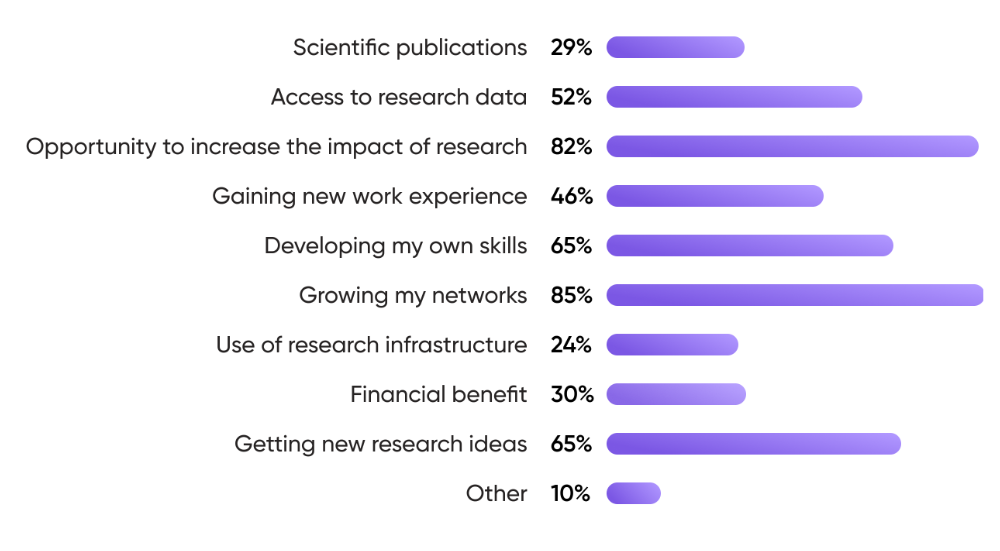
Our survey results show that academics see industry collaboration as a great opportunity to widen their professional networks and increase the impact of their research. Having access to new contacts ties in with increasing research impact because speaking to new audiences brings the research out of the university and into the wider society.

What specific benefits or value do you see for your research in working with companies?
(Respondents: academics, n=107)

Societal impact was a benefit that came across frequently in our in-depth interviews with experienced collaborators and experts. It was also mentioned by enterprises as an important outcome of these collaborations. It appears that societal impact is a key benefit that can equally motivate both parties to engage with one another.

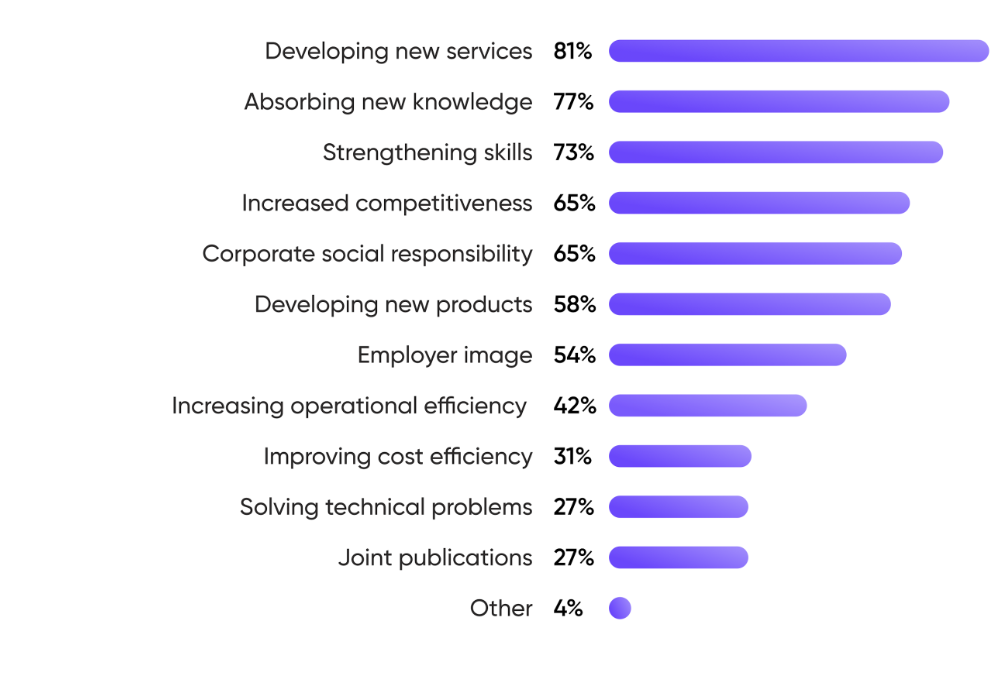
What specific benefits or value do you see for the company in working with researchers in the human sciences? (Respondents: industry representatives, n=26)

What stands in the way of industry-academia collaboration in the SHAPE context?

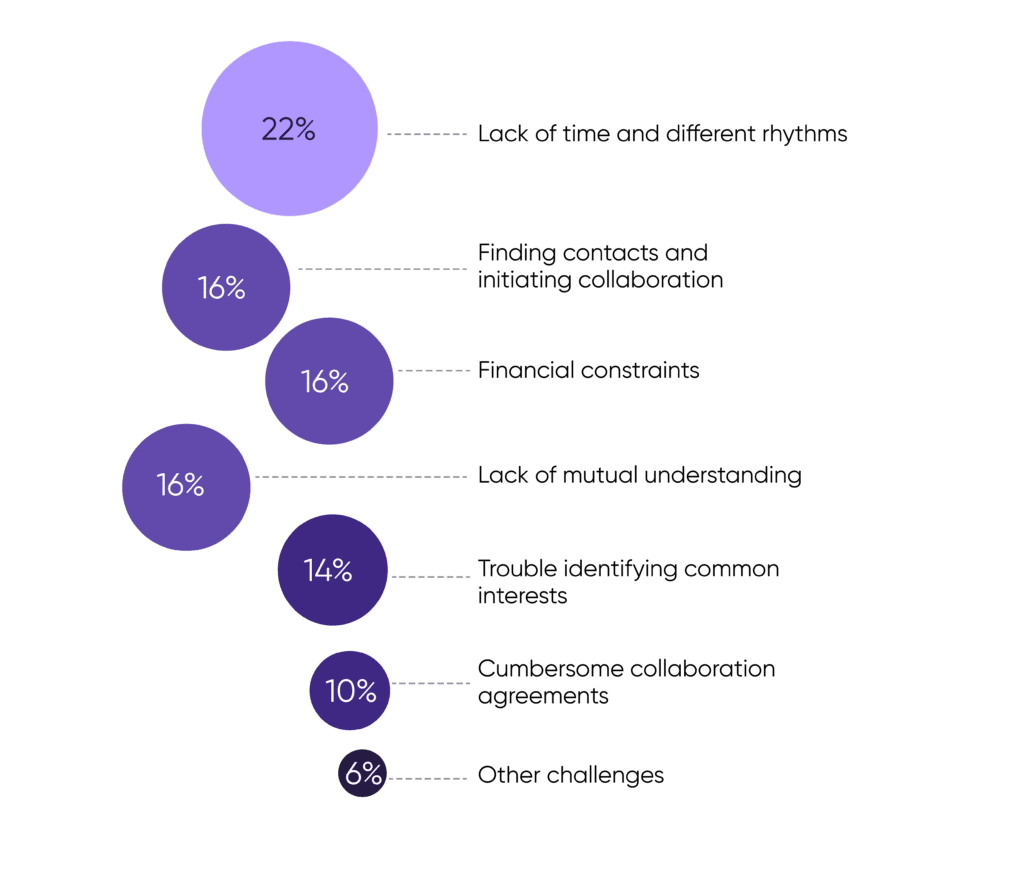
Our data shows that both academics and enterprises can derive benefits from collaborating with one another. Yet, industry-academia collaboration is not widespread in the SHAPE context. We wanted to understand what is keeping researchers and enterprises from working together so that we could then imagine viable solutions. In our survey we asked academics and enterprises to give open-ended answers to this question and discovered several obstacles to collaboration that we then labelled under the following seven categories. Because we received significantly more replies from academics than enterprises, the categories presented here are more representative of the academic perspective.

What obstacles and challenges have you encountered in working with and creating collaboration with companies? (Respondents: Academics and industry respondents, n=103)

How to move on and enhance collaboration between SHAPE disciplines and private enterprises

The future of research is grounded in collaboration. As public funders encourage universities and research institutions to show more leadership in creating societal and economic impact, all disciplines will be affected, including SHAPE. The question is not whether there should be more collaboration between SHAPE and private enterprises, but how that collaboration should be increased and who needs to be involved.

Our findings conclude that the task of enhancing collaboration cannot be accomplished by any one funder, higher education institution, academic or enterprise alone. The necessary changes may be structural, political and technical, but none of these changes can happen without dialogue and collaboration among all the parties involved.

Systemic approaches to collaboration need to be developed to increase collaboration

The challenge: SHAPE researchers and enterprises share a mutual interest in working with each other but struggle to make this happen. The birth of successful collaborations is dependent on individual awareness and interest, and on chance. A more systemic approach requires involvement on the part of universities, academics, funders and enterprises. 

Potential solutions could include:

  • Creating funding calls that are targeted at SHAPE disciplines and that encourage industry-academia collaboration.
  • Supporting academics and enterprises to set up mutually beneficial projects.
  • Setting up structures within universities to exhibit and introduce the work of social sciences, humanities and arts researchers to the private sector.
  • Increasing diversity in corporate leadership to include people with backgrounds in the social sciences, humanities and arts or educating current staff about the benefits these disciplines can offer.
  • Facilitating open-minded discussions about what it means to be an academic who collaborates with the private sector, exchanging experiences with other academics and defining the benefits of this type of collaboration from the academic’s perspective.

Industry-academia networks are key in facilitating collaboration

The challenge: SHAPE academics typically work in very small teams or alone and on small budgets. The lack of teamwork and large-scale projects limits the number of potential contacts for these academics and means they cannot create extended networks through other team members. Without appropriate networks, it is hard to imagine a collaborative project, contact potential collaborators or apply for funding.

Potential solutions could include:

  • Building interdisciplinary teams that help to broaden networks and make new connections.
  • Creating networking events where researchers and enterprises can meet.
  • Encouraging brokerage from universities to establish relationships and connect the right academics with the right enterprises.
  • Creating easy-to-access digital platforms or university consultancies that can help enterprises get in touch with the right researchers.

We need more versatile means to discuss and evaluate research impact

The challenge: In private enterprises, the language and discourse of impact are typically focused on economic outcomes and quantifiable results. Success is measured in terms of patents, products and revenue, which are typically not areas in which SHAPE disciplines can bring most value. Because of this, SHAPE disciplines are often excluded from traditional innovation and R&D spaces but rather employed in other areas of business, such as organisational development. This is not necessarily a problem, but it can limit the potential of academia-industry collaboration and reduce its impact.

Potential solutions could include:

  • Increasing data and evidence on the impact of collaboration through carefully designed trials.
  • Developing impact measures that reflect the unique nature of SHAPE research.
  • Defining the added value that SHAPE disciplines can bring and communicating it effectively, also through quantifiable measures.
  • Challenging the language of innovation and impact to embrace not just economic but also societal, environmental and other types of impact.
  • Providing academics with the necessary skills to talk about their research from the perspective of impact. 
  • Demonstrating case studies of successful collaborations and their impact on both parties involved.

Are you interested in finding out more about the potential solutions that have already been tested or trialed across Europe to increase collaboration between SHAPE disciplines and private enterprises? Download our whitepaper and to learn more about: 

  • Findings from our survey on industry-academia collaboration among Finnish academics and industry representatives.
  • Case studies from Finland, Sweden, Denmark, Ireland and the UK that describe the different approaches to increasing collaboration between SHAPE disciplines and enterprises. 
  • An executive summary that presents all our findings and proposed solutions to take action. 

Would you like to learn more about the whitepaper, please contact the authors: 

aurora.airaskorpi@vaikuttavuussaatio.fi
outi.vanharanta@vaikuttavuussaatio.fi

Author: Aurora Airaskorpi

Filed Under: Blog

  • « Go to Previous Page
  • Page 1
  • Interim pages omitted …
  • Page 3
  • Page 4
  • Page 5
  • Page 6
  • Page 7
  • Interim pages omitted …
  • Page 15
  • Go to Next Page »

Footer

Vaikuttavuussäätiö

Eteläranta 10, 00130 Helsinki
+358 40 767 1631
petro (at) vaikuttavuussaatio.fi

Billing Information →

  • Facebook
  • Instagram
  • LinkedIn
  • Twitter

Privacy Policy →

Copyright © 2025 Vaikuttavuussäätiö